Design
One unit. Every subsystem built in-house.
Argus is built entirely from commercial off-the-shelf components, with chassis and circuit boards designed by the lab. Full subsystem write-ups, photos, and open-source links are coming as the design documentation is released.
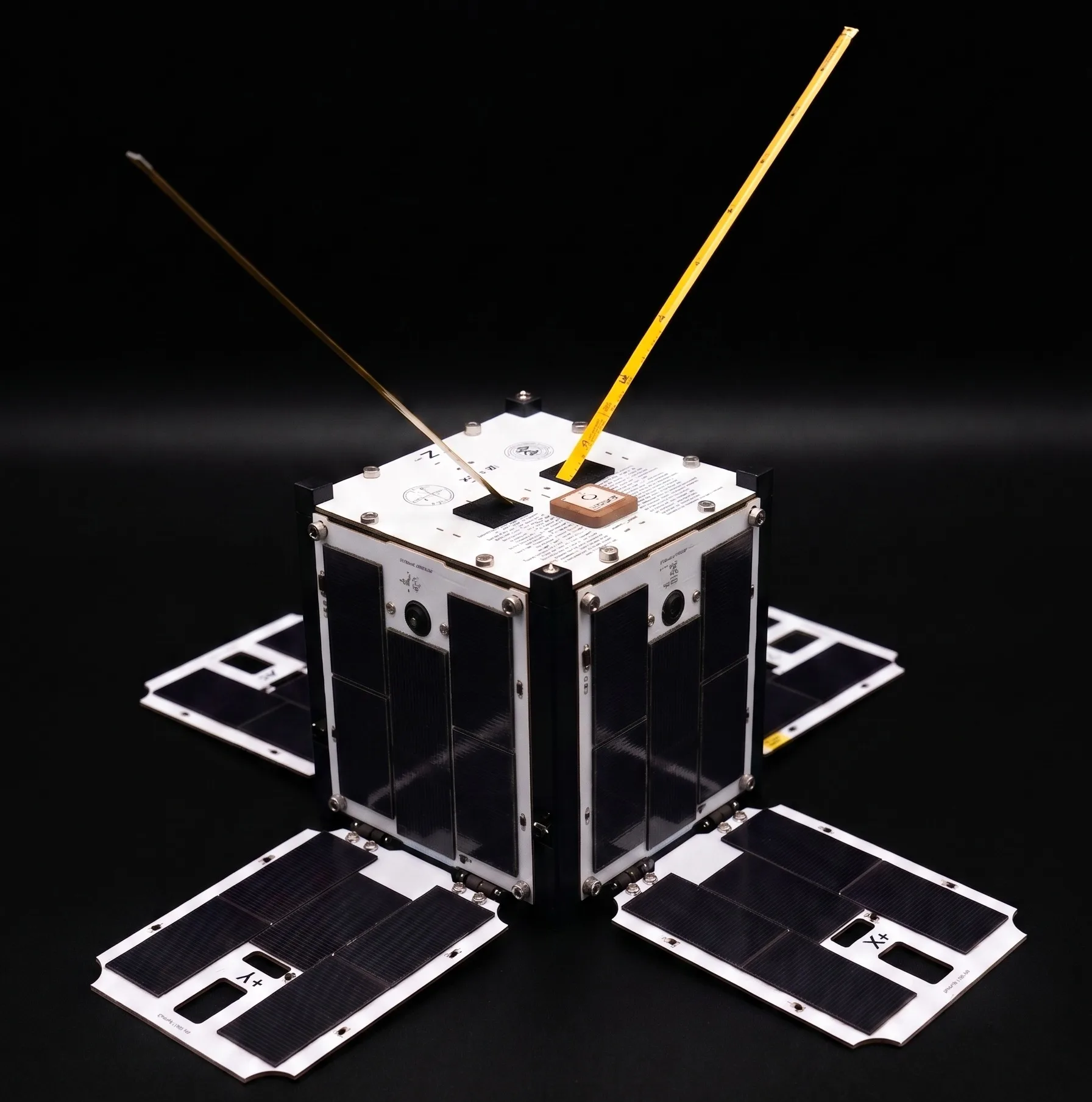
- Form factor
- 1U CubeSat · CDS Rev 14.1
- Flight units
- 2 identical spacecraft
- Primary mission
- Visual orbit + attitude determination
- Compute
- RP2350 OBC + Jetson Orin Nano
- Payload
- Earth imaging + landmark inference + batch estimator
- Reference
- Onboard GNSS
- Software
- Python flight software
- Comms
- UHF · LoRa · GMSK
- Attitude control
- Magnetorquers + experimental reaction wheel
- Architecture
- COTS-based · student-built · open source
Structure
Aluminum 1U frame with steel hardware. Deployable boards mount on anodized aluminum hinges; burn wires on the −Z face release the deployables and UHF antenna after deployment.
Electrical power
Solar panels on every face charge a 2s3p Li-Po pack on the battery board, with a fuel gauge for battery management and per-panel power telemetry.
OBC / flight computer
An ARM Cortex-M33 based Raspberry Pi RP2350 handles all low-level tasks: scheduling, telemetry, command handling, and safety-critical responsibilities.
Flight software
Python flight software built on a hardware abstraction layer, a non-preemptive scheduler, a global state machine, and onboard data handling — portable to a simulator for hardware-free development.
Payload compute
An NVIDIA Jetson Orin Nano interfaces with the cameras, runs the RCNet/LDNet inference models, and executes the batch least squares estimator.
Cameras
Onboard RGB cameras — under 15 g and $100 each — capture the Earth imagery that feeds the visual OD pipeline.
ADCS / IMU
Magnetorquers embedded in the solar panel boards provide attitude control; light sensors provide sun vectors; the IMU's inertial measurements fuse with landmark bearings.
GNSS reference
An off-the-shelf patch antenna and GPS receiver fly for validation only — the truth reference against which visual OD is scored.
Communications
A UHF radio using LoRa with tape-measure antennas handles telemetry and commands, plus the GMSK Doppler experiment and amateur packet repeater.
Ground segment
Ground stations in Pittsburgh downlink mission data — stored in a remote database and visualized on a public dashboard — and uplink encrypted commands.